Case Study: Minor Ingredient Addition DHA
Industry: Grout and Thinset Manufacturing
Purpose of the Case Study
This case study describes a DHA that ADF performed for a powder blending facility that adds a variety of minor, but high cost, combustible powders to a non-combustible blend to produce thinset and grout.
The minor ingredients were added in a highly manual process where 50-pound bags were cut open and dumped into a hopper for transfer to a large paddle mixer.
The bag dumping process generated significant combustible dust clouds in an occupied area and created serious combustible dust accumulation.
Brief Overview of Dust Hazards
Combustible dusts are finely divided solid particles that can ignite and explode when suspended in air under certain conditions.
These particles can originate from various materials and industries, including agriculture, manufacturing, and chemical processing. In industrial settings, combustible dusts pose a significant threat due to their potential to cause fires and explosions, leading to injuries, fatalities, and property damage.
Understanding and managing combustible dust is crucial for ensuring workplace safety and compliance with NFPA 660, the Standard for Combustible Dusts and Particulate Solids.
A requirement of NFPA 660 is for every facility that handles or generates combustible dusts to perform a Dust Hazard Analysis (DHA) to identify the hazards and to develop a plan to implement necessary mitigation steps identified during the DHA.
Project Background and Context
The thinset and grout plant in North Carolina is one of seven nearly identical facilities that had DHAs completed by ADF Engineering. This site was prioritized for the initial design of a solution to reduce dust generated during minor ingredient bag dumping by installing a new rooftop dust collector that returned the expensive powder to the process by gravity.
The existing dust collector at the site was not designed for combustible dust, as the final product is non-combustible. However, this was not suitable for the combustible minor ingredients. Once these minor ingredients are added to the main mixer, the mixture is no longer combustible.
The minor ingredient bag dump stations were originally provided with hoods aspirated to the non-combustible main collector, but these were inadequate to capture the dust clouds.
Facility Description
Facility Overview
The client’s facility is a powder blending plant in North Carolina. It is one of seven nearly identical sites across the U.S.
The Company’s Process and Operations
Dozens of 50-pound bags of minor ingredients are cut open and dumped manually into a pair of hoppers. Aero-mechanical conveyors transport the ingredients to a weigh hopper, which meters the powders into a large paddle mixer where they are mixed into limestone and cement.
Dust clouds generated at the bag dump stations result in expensive material losses and present an immediate combustibility hazard to the operators.
Additional losses and combustible dust accumulation results from material left in the bags after dumping, which are stacked loosely on a pallet for disposal.
ADF’s Dust Hazard Analysis Methodology
Assessment Techniques
The first step in the process is to determine the combustibility characteristics of the dusts handled on the site, based on one or more of the following:
- Historic facility data or published data that are representative of current materials and process conditions; or
- Data provided by raw material suppliers for unaltered raw materials; or
- Analysis of representative samples by testing at a qualified lab.
The specific combustible dust characteristics which need to be determined for each dust includes the following:
A. Kst (relative measure of the explosive potential of the dust, used for sizing vent panels and determining dust hazard classification)
B. Pmax (maximum pressure developed by explosion, used in equipment design)
C. dP/dt max (rate of pressure rise, used in detection instrument design)
D. MEC (minimum explosible concentration, determines limits on dust quantities which may present a hazard)
E. MIE (minimum ignition energy, determines sensitivity to ignition sources)
F. MIT (minimum ignition temperature for dust layer, used in electrical component design, particularly insulation class)
Once the dust characteristics are identified, the next step is to set up the DHA by determining the appropriate areas of risk in the process from current Process Flow Diagrams or P&ID’s, which must accurately show all dust collection or aspiration system connections. The actual DHA review meeting may then be held at the site and must include the following participants, at minimum:
A. Qualified DHA Facilitator
B. Site Engineer
C. Experienced Operator and/or Maintenance Personnel
D. Facility or Operations Manager
E. Site Safety Manager
The duration of the on-site DHA review depends upon the overall complexity and size of the facility, the variety of dust handled and the accuracy and completeness of the process documentation. Information to be identified and evaluated at the DHA includes:
A. Review of all dusts handled and their combustibility characteristics
B. Identification of all potential areas of risk and likelihood
C. Credible ignition sources and suspension mechanisms
D. Safe operating ranges
E. Explosion prevention and protection methods
F. Explosion propagation paths
G. Recommendations for additional protection measures
Finally, the DHA Facilitator will summarize the identified hazards, dust characteristics, current and proposed dust explosion prevention and protection measures and agreed upon implementation plan and schedule to address all gaps in combustible dust risk compliance.
It is this DHA implementation plan to which the site will be held accountable in the event of an OSHA audit or combustible dust incident investigation.
Furthermore, all future changes to the processes or dusts handled must be documented through a Management of Change procedure to determine necessary dust safety system changes and kept with the official DHA documentation by the facility safety coordinator.
Data Collection
The client collects and ships samples per ADF’s direction to the chosen lab for combustibility testing. A typical sample is about 2 liters.
Risk Identification
ADF’s DHAs are done using our proprietary process that combines a checklist-based analysis with a traditional HAZOP approach, utilizing each for their specific strengths to provide a comprehensive analysis.
Project Findings and Analysis
Hazard Identification
The combustible dusts at this client include most of the minor ingredients, which are generally rubber or latex based.
Risk Assessment
ADF’s proprietary DHA approach differentiates the likelihood of a flash fire or deflagration event based on the presence of the components necessary for such an event – namely fuel, credible ignition source, oxygen, containment, and dispersion.
Safety Systems Evaluation
ADF will evaluate existing explosion protection devices. However, there were no pre-existing explosion protection or isolation devices in this process.
ADF’s Post Analysis Recommendations
Preventive Measures
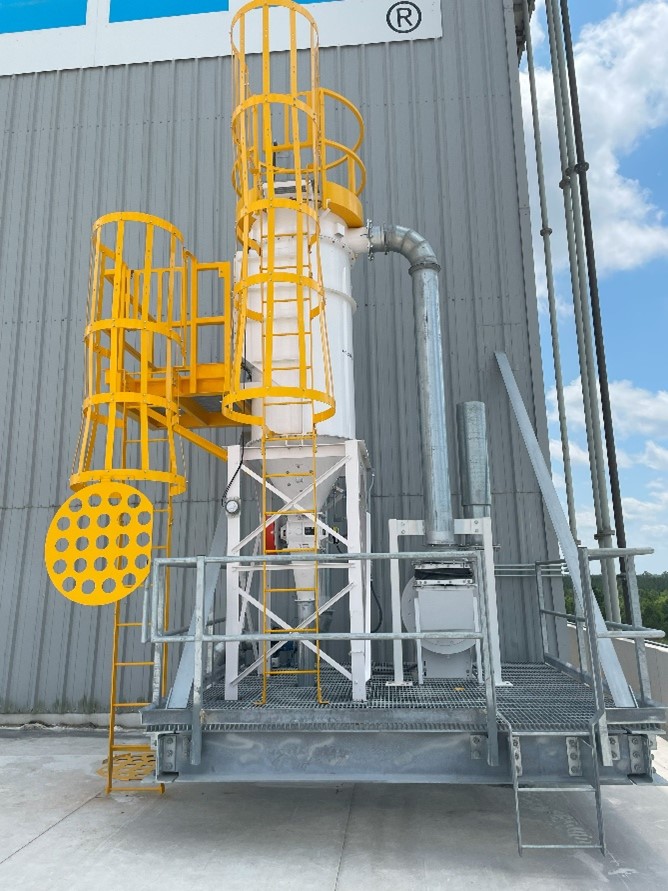
ADF designed rooftop dust collectors that were dedicated to the minor ingredient addition hoppers.
By installing them on the roof, the costly minor ingredients aspirated to the collectors could be returned to the mixer weigh hoppers by gravity.
The aspiration hoods for the bag dump stations were also redesigned for improved dust control.
Employee Training and Awareness
Staff training programs for Dust Hazard awareness were identified as a necessity in the checklist-based DHA review.
DHA Implementation—Our Project Management Approach
ADF’s Project Planning and Execution
ADF managed the dust collector installations and hood modifications following the DHA.
Timeline and milestones
The dust collector upgrades were installed within a year of the DHA.
Innovative Solutions and Technologies
By installing the new dust collectors above the roof, the expensive minor ingredients were able to be recovered to the process.
Since the roof itself could not support the weight of the collectors, platform supports were cantilevered from the central structural tower that held the main mixer below.
Continuous Improvement
ADF was able to duplicate this design for the other client sites with only minor modifications.
Project Conclusion
Summary of Key Findings
High-cost combustible powders can be recovered to the process if the collectors can be installed above the existing equipment.
The improved hood designs significantly reduced the accumulation of combustible dusts in the process area, avoiding an expensive electrical area classification change.
Summary of DHA Implementation
ADF supported the start-up of this process on site and worked closely with the equipment vendors.
The entire project has been copied by the other six plant sites with only minor modifications.
Additional Resources and Educational materials
Webinars:
Updates to Combustible Dust Standards
When Disaster Strikes: Mastering Process Safety in Crisis Situations
Contact Us To Schedule Your DHA
If you need to complete your DHA or update your current DHA, please contact us to schedule a time to discuss how we can assist you.